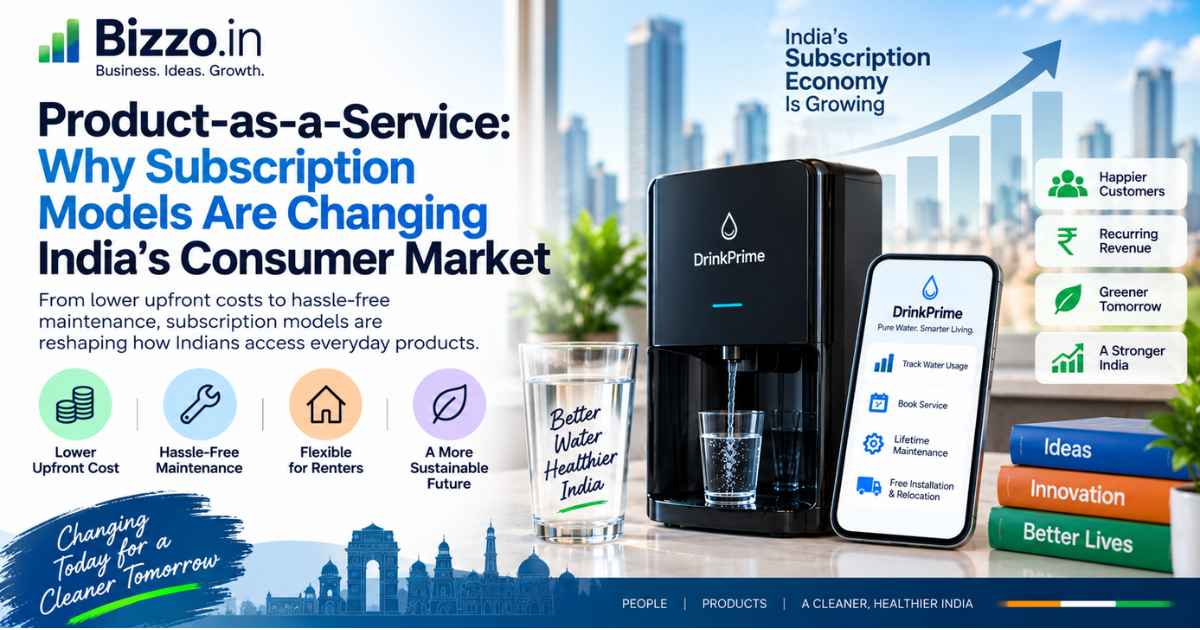
Explore how product-as-a-service and subscription models are changing India’s consumer market, from lower upfront costs to recurring services.
The way consumers purchase products is changing.
For decades, the traditional model was straightforward: a company manufactured a product, a customer purchased it, and ownership was transferred to the customer.
That model still dominates many industries, but another approach is becoming increasingly relevant: product-as-a-service.
Under this model, consumers do not necessarily need to purchase and own a product outright. Instead, they can pay for access to the product through a subscription or recurring service arrangement.
The model is particularly interesting for products that require regular maintenance, upgrades or ongoing support.
From a business perspective, this approach can create a recurring relationship with customers rather than relying entirely on one-time transactions.
What Is Product-as-a-Service?
Product-as-a-service is a business model in which customers pay for access to a product together with an ongoing service.
Instead of simply buying an appliance, for example, a customer might pay a monthly fee that provides access to the appliance along with installation, maintenance or other services.
The exact structure varies by industry.
The important distinction is that the company is no longer selling only a physical product. It is selling an ongoing customer experience.
This changes the relationship between the business and the consumer.
From One-Time Sales to Recurring Revenue
One of the biggest attractions of subscription models for businesses is recurring revenue.
In a traditional product business, revenue is often generated when the customer makes a purchase.
Once the transaction is complete, the company must find another customer to generate another sale.
A subscription model works differently.
A customer who remains subscribed can generate revenue over an extended period.
This can potentially provide businesses with greater revenue visibility and create opportunities for longer-term customer relationships.
However, recurring revenue also comes with greater responsibility.
A company must continue providing sufficient value to convince customers to remain subscribed.
Why Are Consumers Interested in Subscriptions?
The business case is only one side of the equation.
Subscription models can also address several consumer concerns.
Lower Upfront Spending
Buying an appliance can require a relatively large upfront payment.
A subscription spreads payments over time.
This can make certain products more accessible to consumers who prefer smaller recurring payments instead of a larger one-time expense.
Maintenance Convenience
Many physical products require maintenance.
Filters need replacement, components can wear out and servicing may be required.
A service-based model can combine maintenance with the product, depending on the provider and plan.
Flexibility
Consumers may not always want to own every product they use.
Renters, students, young professionals and people who frequently relocate may value flexibility more than permanent ownership.
Subscription models can potentially address this requirement.
Water Purification as a Product-as-a-Service Example
Water purifiers provide an interesting example of how the model can work.
A conventional purifier is generally purchased as a physical appliance.
The customer then becomes responsible for maintaining the system, replacing filters and arranging servicing when required.
A subscription model changes the proposition.
Instead of purchasing the purifier outright, the customer pays for access to the purifier and an associated service.
Depending on the provider and plan, installation, maintenance, filter replacement and other services may be included.
DrinkPrime is an example of a company operating in this space, combining water purification with a subscription-oriented service model.
For consumers researching such services, a DrinkPrime Referral Code may also be relevant when checking whether a current referral benefit is available before starting a subscription.
The referral incentive, however, is only one part of the overall proposition. Consumers should also evaluate pricing, service coverage, purification technology and applicable subscription conditions.
Why the Model Can Work for Businesses
Product-as-a-service can change several aspects of a company’s economics.
Recurring Customer Relationships
Instead of interacting with customers primarily at the point of purchase, businesses can maintain an ongoing relationship.
This creates more opportunities for customer support, upgrades, additional services and retention initiatives.
Predictable Revenue
Recurring subscriptions can provide businesses with a more predictable revenue stream when customers remain active.
This can be valuable for planning operations and investments.
However, subscription revenue should not be confused with guaranteed revenue.
Customers can cancel, downgrade or switch to competitors.
Retention therefore becomes a central business priority.
More Customer Data
Ongoing service relationships can also provide companies with more information about customer usage.
For connected products, this can include information about usage patterns, service requirements and product performance.
Businesses can potentially use these insights to improve products and customer experiences.
The Importance of Customer Retention
Subscription businesses cannot rely only on acquiring new customers.
Retention becomes equally important.
Imagine a company spends heavily to acquire a subscriber but that customer cancels after a few months.
The business may not recover its acquisition cost.
This makes several metrics particularly important for subscription companies.
Customer Acquisition Cost
Customer acquisition cost, or CAC, measures how much a company spends to acquire a customer.
Marketing, advertising, sales commissions and promotional offers can all contribute to acquisition costs.
Customer Lifetime Value
Customer lifetime value, or LTV, estimates the value a customer can generate during their relationship with the business.
A sustainable subscription model generally needs customer lifetime value to justify the cost of acquisition and service.
Churn
Churn refers to customers leaving the service.
High churn can undermine the economics of a subscription business even when customer acquisition is strong.
This is why companies need to continually demonstrate value.
Why Service Quality Matters More in Subscription Businesses
A one-time purchase can sometimes survive a mediocre customer experience because the transaction has already occurred.
Subscription businesses do not have that luxury.
Customers make a recurring decision: Is this service still worth paying for?
That means service quality becomes an ongoing competitive advantage.
For a household appliance subscription, this could include:
- Reliable product performance
- Responsive customer support
- Timely maintenance
- Convenient service requests
- Transparent pricing
- Flexible plans
- Easy cancellation or relocation where applicable
If customers consistently experience problems, they have a direct reason to cancel.
Technology Is Strengthening the Model
Connected devices can make product-as-a-service models even more interesting.
Internet-connected products can communicate information about their usage and condition.
This can help businesses understand when a customer may need maintenance or support.
For consumers, connected technology can provide greater visibility.
Water purification services, for example, can combine a physical purifier with mobile-app features and digital service management.
The result is a product that is increasingly treated as part of a technology-enabled service rather than an isolated appliance.
The Role of Referral Marketing
Subscription businesses also have an interesting advantage when it comes to referral marketing.
A satisfied subscriber has experience with the service and can recommend it to others.
Referral programs can turn existing customers into an additional customer-acquisition channel.
The economics can be attractive when the cost of a referral is lower than traditional customer-acquisition methods.
But referral marketing only works sustainably when the underlying service provides genuine value.
A referral discount may encourage someone to try a service, but the quality of the experience determines whether that customer remains subscribed.
Referral Codes as a Customer-Acquisition Tool
Referral codes are particularly useful because they can connect marketing incentives directly to customer actions.
A business can provide an existing customer with a unique code or link.
When another person uses that referral during signup, the company can associate the new customer with the original referrer.
Depending on the program, the new customer, existing customer or both may receive a benefit.
For subscription businesses, this can create a potentially scalable acquisition channel.
However, referral programs need clear terms.
Customers should understand eligibility requirements, reward conditions and any restrictions before participating.
Product-as-a-Service Is Not Always Better
Despite its advantages, subscription does not automatically mean better value.
Consumers should compare the total cost over the expected period of use.
Someone who uses a product for many years may eventually spend more through subscriptions than they would have through traditional ownership.
On the other hand, someone who only needs a product temporarily may value the flexibility of subscription access.
The decision therefore depends on the consumer’s circumstances.
The Importance of Unit Economics
For businesses, the model needs to work financially.
A subscription company has to account for more than its monthly revenue.
Its costs can include:
- Product manufacturing
- Installation
- Logistics
- Customer support
- Maintenance
- Repairs
- Replacement components
- Technology infrastructure
- Marketing
- Customer acquisition
- Employee costs
If the recurring revenue generated by a customer does not sufficiently cover these costs over the customer’s lifetime, the model becomes difficult to sustain.
This makes unit economics one of the most important considerations for subscription businesses.
Physical Products Create Additional Challenges
Digital subscriptions are relatively straightforward to scale.
A software company can potentially add another customer without manufacturing and delivering another physical product.
Physical subscriptions are different.
Every new subscriber may require another product, installation, transportation and ongoing service.
This means product-as-a-service companies need strong operational systems.
Inventory management, logistics and field-service networks can become major competitive factors.
Sustainability and Product Lifecycle
Product-as-a-service can also change how companies think about the lifecycle of physical products.
When businesses retain a stronger relationship with the product and customer, they may have more incentive to think about repairability, durability and refurbishment.
Instead of treating a product as something that is sold and forgotten, the business may remain responsible for its performance throughout the customer relationship.
This can encourage more attention to maintenance and product lifecycle management.
The environmental impact, however, depends heavily on how the specific business operates.
A subscription model by itself does not automatically make a product more sustainable.
Why India Is an Interesting Market
India has a large and diverse consumer market, making affordability and convenience important considerations.
Many consumers are willing to adopt services that reduce upfront costs or simplify maintenance when the overall value proposition makes sense.
At the same time, price sensitivity remains significant.
This creates an interesting challenge for subscription businesses.
They need to provide enough convenience and service value to justify recurring payments while keeping pricing attractive enough for consumers.
Companies that can balance these factors may have an opportunity to build long-term customer relationships.
Which Industries Could Adopt the Model?
Product-as-a-service can potentially be applied across several categories.
Examples include:
- Home appliances
- Water purifiers
- Furniture
- Electronics
- Vehicles
- Fitness equipment
- Office equipment
- Commercial machinery
The model tends to be more attractive where products are expensive, require maintenance or are used for a limited period.
The success of each category depends on customer behaviour and operating economics.
What Businesses Need to Get Right
Companies considering a subscription model need to think beyond pricing.
Several areas require careful planning.
Product Quality
Customers must receive a product that performs reliably.
Service Infrastructure
The business needs the ability to support customers after signup.
Transparent Pricing
Customers should understand what their recurring payment includes.
Retention
The company needs a strategy for keeping customers satisfied over time.
Customer Acquisition
Acquiring subscribers efficiently is essential for sustainable growth.
Technology
Digital tools can help businesses manage subscriptions, service requests and customer communication.
Operations
Physical products require efficient logistics, installation and maintenance systems.
The Shift From Ownership to Access
The broader trend behind product-as-a-service is a shift from ownership toward access.
Consumers are increasingly familiar with paying for access instead of owning something permanently.
Streaming services changed entertainment.
Software subscriptions changed how many businesses access productivity tools.
Mobility services changed parts of urban transportation.
The same thinking can now be applied to physical household products.
Consumers may increasingly ask:
“Do I need to own this product, or do I simply need reliable access to it?”
That question creates opportunities for businesses willing to redesign their products around services.
What This Means for Traditional Businesses
Traditional manufacturers may also have an opportunity to participate in this shift.
Instead of competing only on the upfront price of a product, manufacturers can potentially create service layers around existing products.
This could include:
- Maintenance plans
- Extended service packages
- Subscription access
- Upgrade programs
- Financing
- Refurbishment
- Connected-device services
Such models can create additional revenue streams while strengthening relationships with customers.
However, the transition requires changes in operations and organizational thinking.
A company accustomed to one-time transactions must learn how to manage ongoing customer relationships.
The Future of Subscription-Based Products
Subscription models are unlikely to replace traditional ownership completely.
Consumers will continue purchasing many products outright.
But there is room for both models.
The deciding factor will often be convenience, economics and flexibility.
For products requiring regular servicing, frequent upgrades or temporary use, product-as-a-service can be particularly compelling.
For durable products that consumers expect to use for many years with minimal maintenance, ownership may remain preferable.
The businesses that succeed will be those that understand where subscription genuinely creates value rather than forcing the model onto every product.
Final Thoughts
Product-as-a-service represents a significant change in how businesses can think about selling physical products.
Instead of focusing solely on the initial transaction, companies can build ongoing relationships around access, maintenance, technology and customer service.
For consumers, the model can offer lower upfront commitments and greater convenience in certain situations.
Water purification is one example of how this approach can be applied to an everyday household need. Subscription-based services combine the physical product with an ongoing relationship between the provider and customer.
Referral programs can further support these businesses by encouraging existing customers to introduce new users.
Ultimately, however, the success of any subscription business depends on the fundamentals: product quality, pricing, service, customer satisfaction and sustainable unit economics.
The future may not be about choosing between ownership and subscriptions. Instead, consumers may increasingly have the option to choose whichever model provides the best combination of value, flexibility and convenience for their particular needs.